William Hague
challenges and difficulties
William Hague has a great capacity for self-denial in the pursuit of a long-range goal. William is capable of hard work and persistent labor, but he may lack the capacity for joy and play. William Hague often feels burdened by life's demands and responsibilities, and may envy those who seem to attract what they want in life without a great deal of personal effort.
There is a very judgmental, stern, and uncompromising side of Hague's that may inhibit him a great deal. William Hague must avoid becoming cumbersome and cynical, or a rather callous, sophisticated adult whose sense of practicality and realism rob him of the playful, imaginative side of life.
He may have vague but ever-present feelings of guilt and fear that are difficult to pinpoint or eradicate. It is as if William Hague does not trust Life itself, and is always seeking ways to defend himself from its dangers and its unknowns. William Hague must learn to overcome his ingrained habit of discouragement and anxiety, and to see the world more as a friendly place than as a treacherous one.
His aspirations and dreams are always tempered by realism and practical considerations. William Hague pursues his aims in a systematic, disciplined and thorough manner, and he is willing to take his time, advancing slowly and steadily toward his goal.
Sometimes William Hague underestimates what is possible, and holds himself back unnecessarily due to a lack of faith or an overly cautious attitude.
His disposition is somewhat melancholic and William Hague may have a rather pessimistic outlook. William has an inner need to be alone and to engage in deep meditation. William Hague takes life seriously and may have been taught early on to learn from his mistakes.
Now we will discuss patterns of behavior which William Hague instinctively and habitually reverts to when under stress - a mostly subconscious process that he is apt to over indulge in because it is so familiar and hence easy for him. The direction William Hague needs to follow in order to develop balance, greater awareness, and wholeness is also described.
His natural instinct, especially when under stress, is to passively go along with whatever is easiest, refrain from clearly analyzing or assessing his situation and perhaps even try to escape from seeing his situation clearly by indulging in fantasies, intoxicants, and the like. Dreaminess and impracticality, being unfocused and undefined (at least in certain areas) are ways William Hague copes with stress. William Hague also has trouble setting limits and saying no.
His development path lies in cultivating discrimination and clarity, becoming more precise, and developing technical and practical skills that will enable William Hague to function more efficiently in the world. Finding a way to be of practical service is also important.
It is in his marriage and other intimate, one-to-one relationships that he is most likely to wrestle with these issues. He may see the qualities that he needs to develop more fully (described above) in his partner. It is important for William Hague to recognize, appreciate, and listen to the people in his life who express such attributes, as well as to develop them himself. William Hague has to put energy and attention into learning about others, and about himself through others.
The specific habits which are likely to hold William Hague back, or which he is prone to overdo, especially during stressful periods, include:
Excessive thinking, rationalizing or talking, the overuse or misuse of Hague's intellectual abilities and the tendency to allow his energy to be dissipated in trivial activities.
The following are specific activities that will support William Hague in his growth. These may or may not feel natural to Hague, and he may initially resist or feel awkward about them, but they are crucial to his path to wholeness.
William Hague's path to wholeness involves confronting his dark and hidden recesses, bringing them out into the open, and transforming himself in the process. Healing abilities develop as a result of Hague's willingness to experience and transform deep emotions such as grief, anger, and pain. Furthermore, bringing light to the darkness and pain in the world without becoming overwhelmed by it is a significant challenge for William.
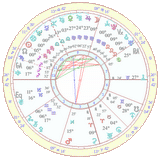
Astrological factors in this Astro Profile section:
Saturn in Capricorn
Saturn in 12th house
Jupiter Conjunct Saturn
Saturn Conjunct Mercury/MC
N. Node in Virgo
N. Node in 7th house
N. Node Opposition Mercury
N. Node Conjunct Pluto

|