Ernest Hemingway
challenges and difficulties
Ernest Hemingway has a critical, cynical attitude towards many religions and philosophies. Without realizing it, he prevents himself from appreciating new viewpoints and attitudes. Hemingway is more rigid and dogmatic than he realizes. His approach may also be too intellectual or moralistic. Ernest Hemingway takes his own political beliefs and spiritual philosophy very seriously, worrying and fretting if he is not 100% clear about some ideology or theory.
His childhood or his relationships with his parents was restrictive, unloving, or unhappy in ways that may prevent Ernest from allowing other people to get close to him in later life. Ernest Hemingway felt deprived in some manner, whether or not he actually was deprived in some way. Emotional separations or repression of his needs and feelings may typify his early life, at least as Hemingway remembers it. Forgiving his parents and/or letting go of any resentments he has about the limitations that he experienced early in his life is crucial. Also, Ernest Hemingway needs to build his own solid foundation, and investing time and energy into his home, domestic relationships, and inner life can help Ernest accomplish this.
Ernest Hemingway feels that he must work very hard and struggle against tremendous odds that impede his chances of fulfilling his life's ambitions. Ernest may adopt a very hard, cynical, or nihilistic attitude that will only drag him down further. There are major problems with his father or figures of authority. Ernest Hemingway may fail simply to spite "them", without realizing that he is primarily hurting himself. If he can overcome his feelings of loneliness, bitterness or isolation, and direct his energies toward constructive endeavors, Hemingway can be immensely effective because of his tremendous tenacity and potential for achievement.
When he is with others, Ernest Hemingway often may suddenly become inhibited. He is inclined to be afraid of confrontations and probably will avoid group activities as much as possible.
Now we will discuss patterns of behavior which Ernest Hemingway instinctively and habitually reverts to when under stress - a mostly subconscious process that he is apt to over indulge in because it is so familiar and hence easy for him. The direction Ernest Hemingway needs to follow in order to develop balance, greater awareness, and wholeness is also described.
It is easy for Ernest Hemingway to become distracted from his path by the multitude of interesting choices, possibilities, and options available to him. Ernest Hemingway needs to develop single mindedness and focus. Until Ernest directs his attention to some of the big questions, such as "What is my life's purpose?" "What is really important to me and essential to my happiness?", he is apt to dabble, scatter his energies in many directions and engage in activities which are entertaining but ultimately neither fruitful nor enriching.
Having an overall vision for his life and aligning his daily activities so that they support rather than detract from Hemingway's larger purpose in life, is a significant step toward his personal development.
It is in trying to strike a balance between Hemingway's inner, personal life and his career or involvement with the world at large that he is most likely to wrestle with these issues. Ernest Hemingway needs to focus attention on his home and family situation, and create a secure inner anchor.
The specific habits which are likely to hold Ernest Hemingway back, or which he is prone to overdo, especially during stressful periods, include:
Escapism through fantasy, intoxicants, or unreal, vicarious activities (television, movies, etc.), passivity, waiting for a miracle instead of taking constructive steps to help himself, aimlessness or an inability to make and keep commitments, and self deception regarding other people, being a martyr.
Ernest Hemingway has a tendency to shy away from other people, and he reacts toward others in an almost fearful way. Hemingway seems to lack confidence in himself and for this reason may feel that he lacks the ability to adapt easily into relationships with others.
Hemingway makes a big impression on everyone he meets and has the ability to attract many people. Others find Ernest Hemingway very fascinating and he is likely to see himself as their model or example in groups or associations.
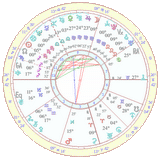
Astrological factors in this Astro Profile section:
Saturn in Sagittarius
Saturn in 4th house
Saturn Opposition Pluto
Saturn Conjunct Uranus/N. Node
N. Node in Sagittarius
N. Node in 4th house
N. Node Opposition Neptune
N. Node Conjunct Moon/Saturn
N. Node Opposition Venus/Pluto

|