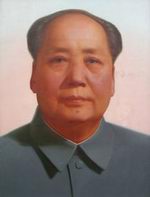
Mao Tse Tung
approach to life and appearances
The following is a description of Mao's basic stance toward life, the way others see him, the way Mao Tse Tung comes across, the face he shows to the world. In the page about motivation you will read about the inner Mao Tse Tung - his real motivation, which describes the kind of person he is at heart and where his true priorities lie. Study this page and the next one and compare them - there may be significant differences between the two, in which case "the inner Mao Tse Tung" may not shine through and others may be in for so a few surprises once they get to know Mao a little better. This page describes the disguise Tse Tung wears, his role in life, while the page about motivation talks about the real person beneath the disguise.
Cautious, prudent, and rather self-contained, he is a person who approaches life realistically and who is not inclined to take foolish chances or get carried away by the overly optimistic or idealistic schemes of starry-eyed dreamers. In fact, Mao Tse Tung frequently has a jaundiced view of such things. He is rather worldly-wise at a fairly young age, even somewhat of a cynic. Often the world does not seem like a safe, friendly place to Tse Tung, and he tends to approach life in a guarded, conservative manner. He is generally calculated and careful, and is rarely spontaneous, fluid, open, and childlike.
He is pragmatic, shrewd, and an excellent strategist, carefully planning his moves for maximum effectiveness and advantage. He is willing to work long and persistently for what he wants and he often does things the hard way. Mao does not expect others to take care of him and sometimes refuses or simply does not seek any outside help. He is often very ambitious, but quietly so. There is nothing flamboyant or flashy about his approach. He is very responsible, conscientious, and concerned with his duties to others and how he comes across socially - his "rank" so to speak.
To others Mao Tse Tung seems mature, serious, quiet, reflective, and emotionally detached. Mao dislikes sloppy sentimentality and will not openly display his feelings, especially the more tender ones. Tse Tung likes to always appear poised and in control; and he hates to show any weakness, vulnerability, or chinks in his armor.
Mao Tse Tung respects tradition and the time-honored way of doing things, and he feels that there is much to be gained from studying history and also by learning from older, more experienced people. A wise mentor or father is often Tse Tung's guide in life, and he in turn develops a great deal of hard-earned wisdom, which he likes to impart to younger people.
Mao Tse Tung has a stern, authoritarian, no-nonsense aspect to his personality. He expects much from himself and may not give himself enough leeway to experiment and make mistakes.
He also tends to be rather close-fisted, to save and conserve his money and resources rather than spending or enjoying them. Mao Tse Tung spends money on things of quality and of lasting value, things which are good investments, but not frivolous, temporary pleasures. There is a bit of the ascetic in him. Mao exercises great self-discipline and self-control and he can "do without" very well. His tastes are generally understated and simple.
Though he may have other, more colorful and imaginative sides, the face Tse Tung shows the world is modest and rather conservative.
Mao Tse Tung appears to be unusual, highly independent, and a free spirit. There is a touch of brilliance, of the creative genius, in his manner. He is also restless and easily distracted, tending to fly from one thing to another, which may give the impression that Tse Tung is unreliable.
In significant ways, Tse Tung's emotional nature and personal needs are at odds with the way he presents himself. As a result of this inconsistency, Mao Tse Tung may be uncomfortable showing his instinctive responses and true feelings. He may put them aside, maybe even be ashamed of them.
When Mao Tse Tung is in an emotionally charged situation, those who do not know him well may be quite surprised at his reactions or behavior. The real challenge, though, is to completely accept himself, so that he does not act as if his emotional needs and impulses did not count for very much.
There is a receptive, elusive quality to Mao's personality. Tse Tung can be difficult to pin down, difficult to know, something of a mystery. At times Mao Tse Tung may feel frustrated because he feels that he is not being perceived very clearly, that he does not make a powerful impression, that he is easily overlooked or discounted. If he does not wish to be "invisible", Tse Tung must make some effort to define and clarify - both for himself and for the rest of the world - who Mao Tse Tung is. On the other hand, Mao Tse Tung may purposely create illusions about himself with the intent to deceive - or entertain - others.
Mao Tse Tung has a sympathetic understanding of others and the ability to see through people. Very sensitive, his emotional state depends a lot on the influence of his immediate surroundings and relationships. For this reason others may see Mao as a somewhat unstable person.
Mao Tse Tung has a tendency to react violently to the influence of his surroundings and to throw himself headlong into everything he does, suffering the consequences later on. Until Mao learns to alter his conduct, there are likely to be many upsets in his relationships.
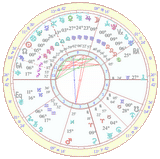
Astrological factors in this Astro Profile section:
Capricorn Rising
Uranus Sextile Asc.
Moon Quincunx Asc.
Neptune Quincunx Asc.
Asc. Opposition Moon/Neptune
Asc. Opposition Moon/Pluto

|